
Parsertime v3.0 - The biggest update yet
by Lucas Doell, Founder / Lead Developer
This is the biggest update we've ever shipped. v2.0 reworked how Parsertime looks and feels back in December; v3.0 is about six months and a couple thousand commits of work since then, which is why it's so much larger. Up to now Parsertime has mostly been good at telling you what happened in your scrim. This release starts answering the things that happen around it: scouting the team you're about to play, seeing where your own team actually ranks, and finding new teams to scrim. There's a lot in here, so I'd grab a coffee.
If something breaks, please tell us through the Report a Bug menu in the app or in our Discord. Happy scrimming!
FACEIT Scouting
Opponent prep used to mean opening a stack of FACEIT match pages and trying to hold it all in your head. Now you search a team or a player and get a report you can actually use.
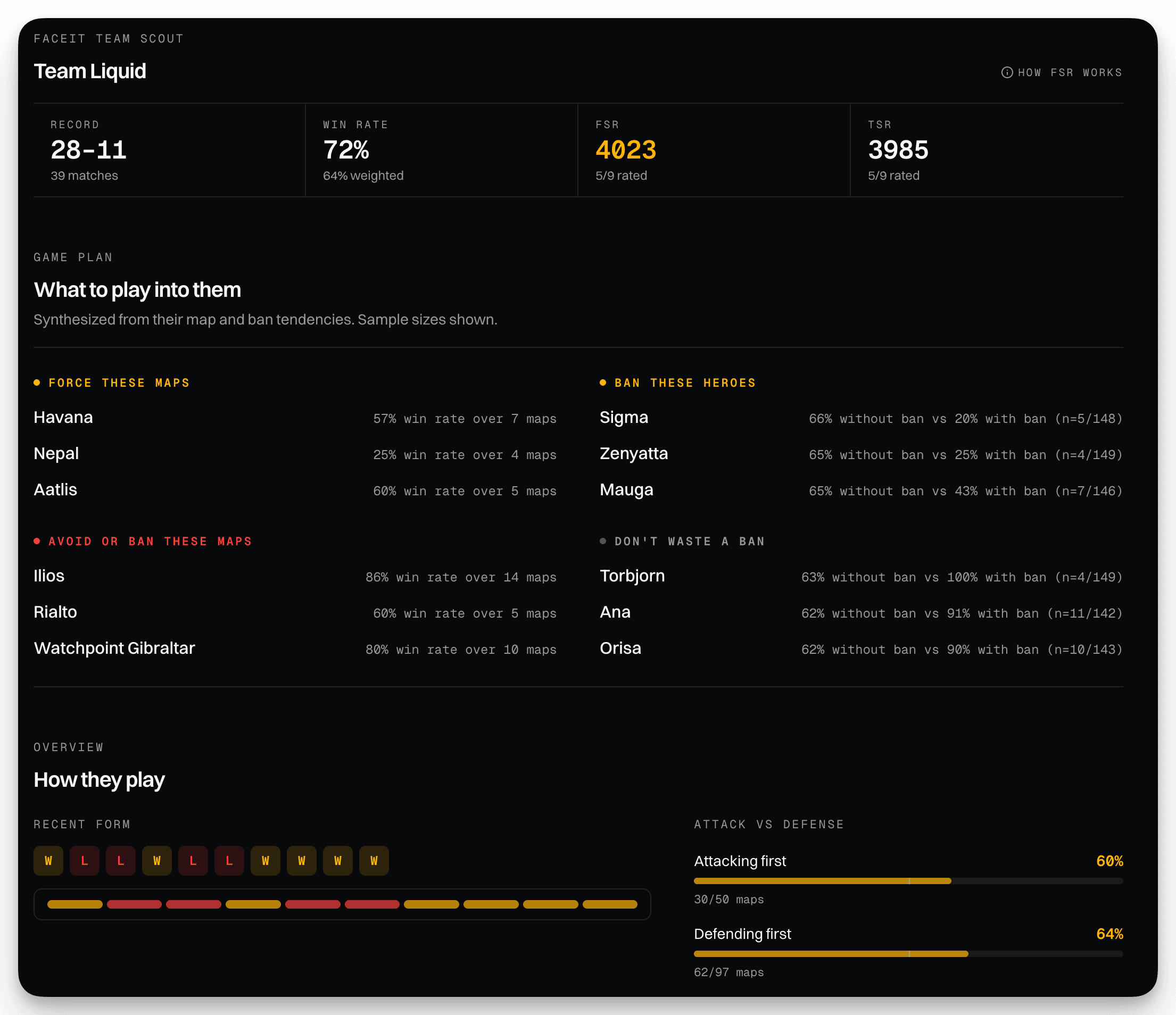
Scout a team and you get their recent form, the tiers they've played, how they do per map and mode, their attack-versus-defense split, which hero bans actually hurt them, and a patch timeline so you can tell whether a good record is current or left over from an old meta. Up top there's a short game plan: maps to force, maps to avoid, heroes worth banning, and heroes that aren't. Every call comes with the win rate and sample size behind it, and if the data is too thin to say anything useful, it tells you that instead of making something up.
Scout a player and the page is built around one question: how dangerous are they, and where. You get a read on what they punish you with and where they're soft, plus their best and worst maps.
FSR
The number at the center of all this is FSR, the FACEIT Skill Rating. It's a single score from 1 to 5000 that estimates how good a player is from their in-game stats, not from whether their team won. It's worked out per role and anchored to the tier they play at, so a support is measured against other supports at their level instead of the whole ladder. It leans on recent games, weights higher tiers more heavily, and pulls back when the sample is small, so someone farming Open lobbies can't out-rate a Masters regular. A radar chart shows where they're strong and where you can lean on them.
Note: FACEIT Scouting is a premium feature and is rolling out behind a flag, so it might not be on your account yet.
Tournament Skill Rating (TSR)
v2.0 added CSR, which compares your hero play against the whole player pool. v3.0 adds TSR, which measures something different: how your team does in real tournaments against the specific teams you played.
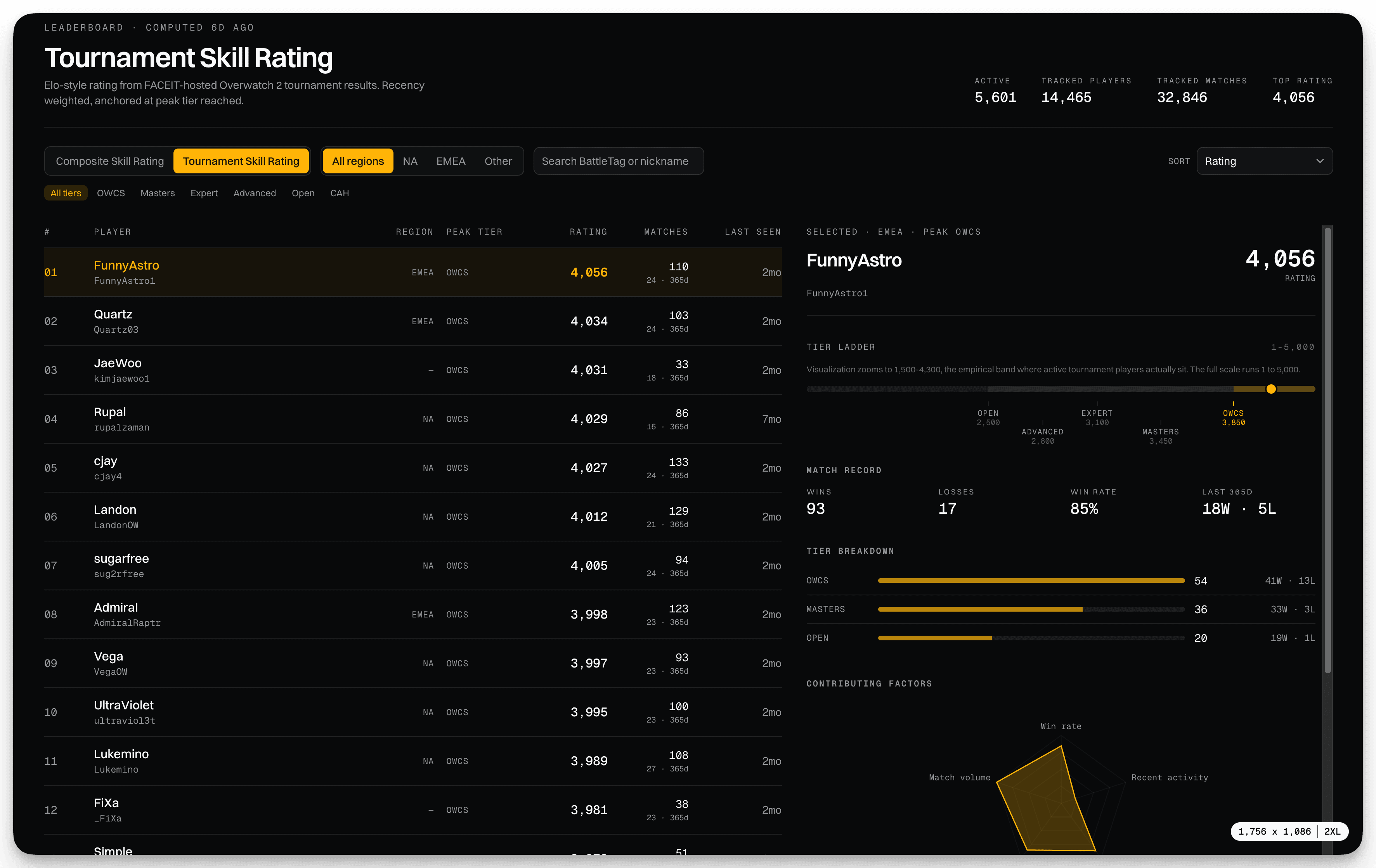
TSR is an Elo-style rating built from FACEIT tournament results, scored from 1 to 5000 and centered on 2500. A few things worth knowing about it:
- You start anchored to the highest tier you've ever reached, from Open up to OWCS, so an old OWCS player doesn't begin at the bottom and a climber isn't stuck there.
- A 2-0 counts for more than a 2-1, and old matches fade out over a year, so the rating tracks how you're playing now.
- NA and EMEA are separate ladders, kept in line by the cross-region games that do happen.
- Gains slow down near the top so the ceiling stays meaningful, but losses never do, so a big upset still stings.
It recomputes every night, and again on the spot whenever FACEIT reports a finished match. Link your FACEIT account under Settings, Linked Accounts, and your history gets pulled in automatically.
A reworked leaderboard, and Team TSR
The leaderboard is now a hub with two boards: the CSR hero rankings you already had, and the new TSR rankings. Teams get a Team TSR card too. It's a playtime-weighted average of the active roster's ratings, with a confidence label that's honest about how much of it is measured versus predicted. Team TSR is what feeds the Matchmaker.
Matchmaker
Finding a scrim at your level is half the work. The Matchmaker pairs teams by Team TSR bracket inside your region and hands the request off to the other team's Discord.
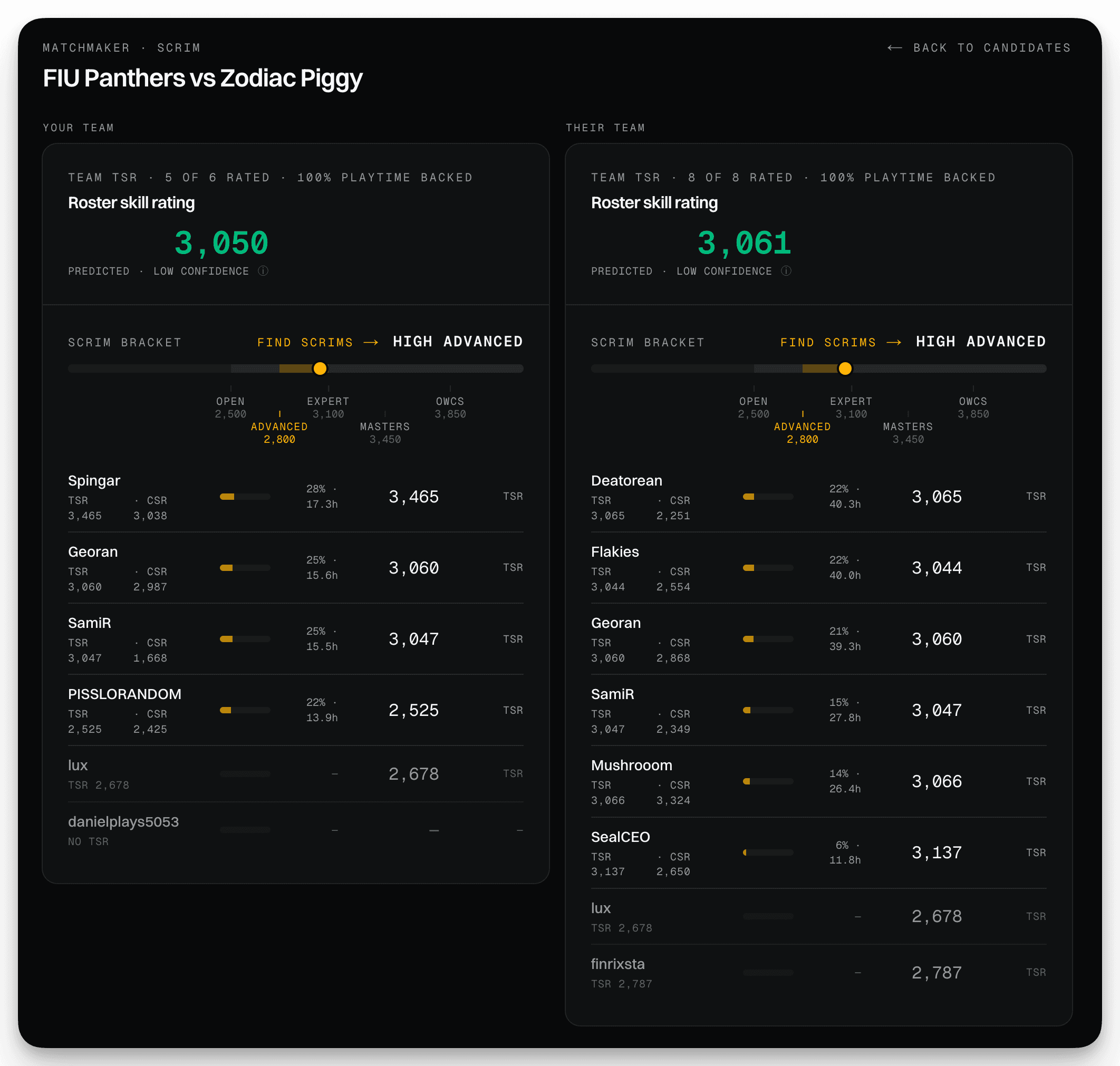
Open your team's page in it and you'll see teams in nearby brackets, each row showing their bracket, the rating gap, how recently they've been active, and their availability if they've filled it in. Click through for a side-by-side that lines the two teams up on TSR, recent form, hero pools, shared maps, and overlapping free time, then send a request. The other coach reads it in Discord and replies however coaches already talk to each other. Requests are capped (one a day to any single team, ten a day total) so nobody gets spammed, and only aggregate numbers are ever shown, so nothing from your actual scrims leaks out.
Win probability, Match Story, and the Simulator
v3.0 adds a win-probability model trained on anonymized scrim data pooled across teams, and it shows up in a few places.
Match Story
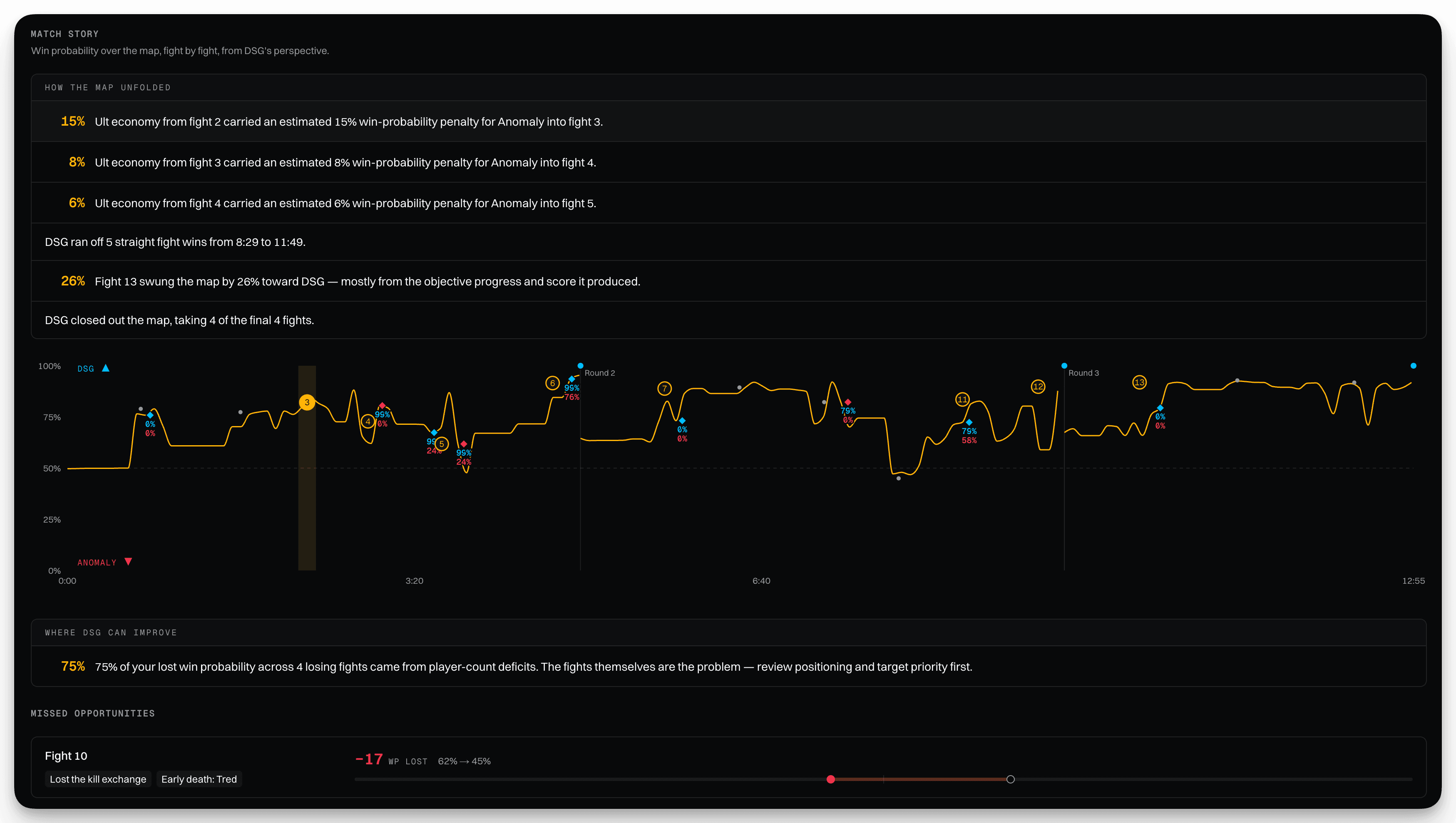
Every map now has a Match Story tab that reads the game back to you fight by fight: how the map was won or lost, when it turned, and why. It's there for the question you ask after every scrim, which is some version of "why did we lose that," without making you rebuild the whole thing from the stat sheet.
WPA
The same model gives you WPA, Win Probability Added, which is how much each player moved their team's chances over the course of the map. It's a way to ask who actually swung the game, rather than who padded the most damage. It rolls up across a whole scrim too, so you can see who carried a block.
The simulator
Premium teams get a Simulator tab that estimates your win rate for a game that hasn't happened yet, based on the bans, the map, and the comps. It's good for sanity-checking a draft, or working out which ban would hurt you most before you load in.
Fight Initiation
The new Initiation tab, which teams call "going first," looks at whether your aggression is paying off. It grades each fight by who threw the first punch and whether they came out ahead. It treats going first as a team decision, not one player's highlight, so it's looking for a real commit (a two-person dive, an ult, abilities going off together) rather than a lone pick. The fights it most wants you to find are the ones where you went first and still lost, because those are the ones worth reviewing.
Positional tools
The parser now tracks where players are on the map, which opens up a set of spatial views on paid plans. These need position data and a calibrated map, so older scrims won't have them.
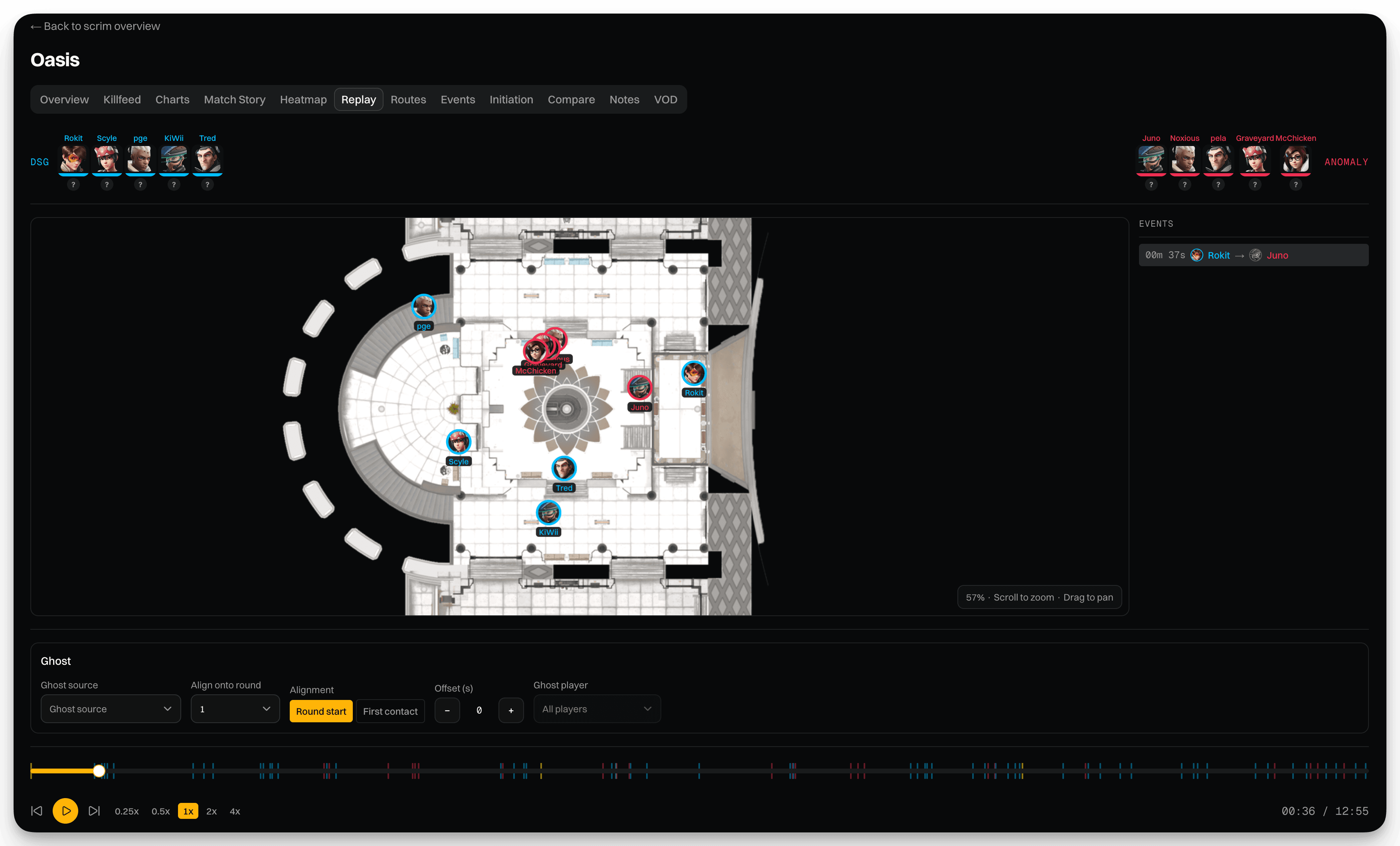
- The replay viewer plays a map back with everyone's markers, kills, and ults on a timeline you can scrub. Ghost overlays let you drop another run on top of the current one, so you can put the push that worked next to the one that didn't, or this week against last week on the same map. The timestamp lives in the URL, so you can paste a link straight to the moment you want someone to look at.
- Routes draws the actual paths teams took from spawn to first contact, colored by whether the round was won or lost, so you can compare the approaches that worked against the ones that didn't.
- Tendencies colors each part of a map green where you tend to win fights and red where you lose them, with a per-zone scorecard underneath.
- The team Positional tab and the per-player Positioning card cover engagement distance, high-ground kills, deaths with nobody around to peel, and how spread out you are when fights start. The definitions are the same at every level, so an outlier is really an outlier.
AI Analyst
Instead of clicking through tabs, you can just ask. The Analyst answers plain questions about your scrim data, things like "how did we do on Ilios last week" or "who's fallen off on support this month," and backs each answer with cards you can open up and check.
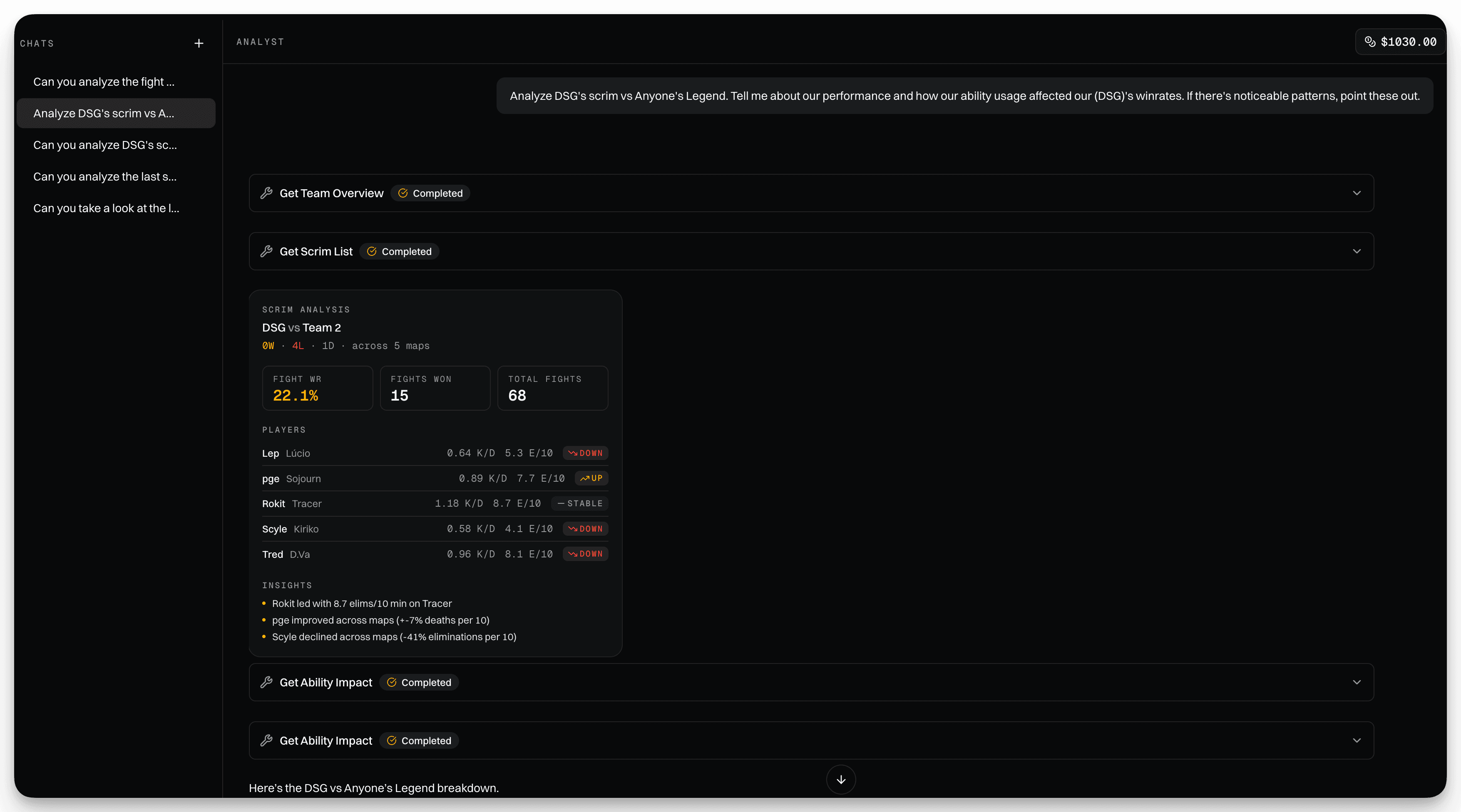
It runs on a credit balance instead of a subscription: top up once, chat until it runs low, and turn on auto-refill if you'd rather not think about it. Old conversations stay in a sidebar so you can come back to them.
Ranked tracker
Not everything here is about your team. The ranked tracker is your own competitive dashboard, free for anyone signed in, private unless you decide otherwise, and not tied to a team at all. Log or import your ranked games and it fills in your trends and win rates, broken down by hero, map, time, patch, group size, and role. It answers the stuff a shared team page can't, like which hero you should stop forcing, or whether you're honestly better solo than in a stack. You can bring your history over in bulk with a JSON import, and publish a summary to your public profile if you want to.
Coaching Canvas
The Coaching Canvas is a full-screen map you can draw on, with hero tokens you drag around, for chalking up plays and walking through fights. The drawing board is free for everyone. If you're on Basic or Premium, you can pull a real fight out of a scrim and the canvas opens with everyone already placed where they actually stood when it kicked off, so you're breaking down a real moment instead of one you're half-remembering.
Availability calendar
Working out a practice time everyone can make is now one shared grid. A manager sets up the week (slot length, the hours that matter, a home timezone) and shares a link; players click when they're free, no account needed, and the grid gets darker where more of them overlap. The week now starts on whatever day your Discord reminder goes out, so the reminder lands on day one and people get the full week to fill it in. The whole thing is free.
Discord bot
The Parsertime bot brings your data into your server, free for everyone. Pull up a profile, compare two players, or check a leaderboard with slash commands like /profile, /leaderboard, /compare, and /team; link your account and you get personal ones like /teams. It's also what delivers most of the new stuff: the weekly availability nudge, new-scrim announcements, Matchmaker requests, and low-credit warnings all land in your team's channel.
Player targets
Premium teams can turn coaching notes into goals you can track. A coach sets per-player stat targets that fit the role (mitigation for tanks, healing for supports, and so on), and the player gets a Targets tab with trend charts, a progress donut, and a plain line telling them whether they're heading the right way.
Known Issues
- The full list lives on our known issues page. The one worth flagging here: the positional features (replay, routes, tendencies, positioning) only work on maps we've calibrated. If you play a map we haven't gotten to yet, those tabs just won't show up.
Patch Notes
- Added FACEIT Scouting with team and player reports, a short ban-and-veto game plan, and FSR, a stats-based rating worked out per role and tier on a 1 to 5000 scale (premium, behind a flag)
- Added Tournament Skill Rating (TSR), an Elo-style rating from FACEIT tournament results, with max-tier anchoring, margin-of-victory and recency weighting, separate NA and EMEA ladders, and a soft cap near the top
- Reworked the leaderboard into a hub with separate CSR and TSR boards, and added a Team TSR card
- Added the Matchmaker for finding scrims by bracket and region, with requests delivered to Discord and daily caps
- Added a win-probability model behind the new Match Story map breakdown, WPA at the map and scrim level, and a Premium win-probability Simulator
- Added the Fight Initiation tab, which grades who went first and surfaces the fights you opened and lost
- Added positional tools on paid plans: the replay viewer with ghost overlays and shareable links, Routes, Tendencies fight maps, and team and player positioning stats
- Added the AI Analyst, a chat over your scrim data backed by real cards and paid for with credits instead of a subscription
- Added a personal ranked tracker: free, private by default, with hero, map, time, patch, group, and role breakdowns and bulk JSON import
- Added the Coaching Canvas (drawing free; importing real fight positions on Basic and Premium)
- Added the team availability calendar with timezone-aware slots, public password-protected links, and reminder-aligned weeks (free)
- Expanded the Discord bot with profile, leaderboard, compare, and team commands, plus availability reminders, scrim announcements, and Matchmaker delivery
- Added Player Targets so coaches can set per-player goals and track them (Premium)
- A long tail of parser fixes, speed-ups, and reliability work across the app
Attribution
A special thank you for the players and coaching staff of Disguised for assisting with coordinate data collection and providing feedback on new features.
Thanks to our beta testers for putting v3.0 through its paces and helping us ship something this big with some confidence. If you want to help test future releases, join our Discord and let us know.
Contributors
- Lucas Doell (@lucasdoell)